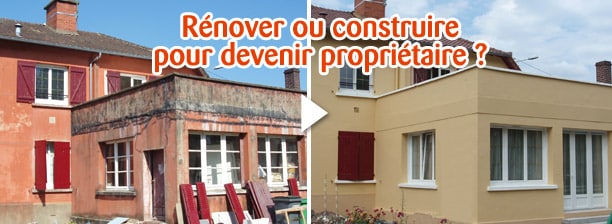
Becoming a homeowner is the dream of most tenants. However, it can quickly turn into a nightmare if you do not take the usual precautions or if you try to save money where you shouldn’t. Indicate whether you want to renovate old properties or build new ones. Although around 240,000 new buildings are completed each year, renovation remains the most chosen solution for real estate installation. New buildings have become much cheaper to buy and come with some disadvantages.
To help you choose, here are the right questions:
What is the goal?
Escaping a rental situation, where landlords, neighborhoods, and restrictions impose on you, is not a decision to be taken lightly. It is up to you to define your goals and objectives for your future home. Should it have a practical appearance, a large kitchen, many rooms, a big garage, a basement…? Is the environment important to you? The distance from work, nearby shops or schools, and the proximity of neighbors are points that need to be considered. Aesthetic selection or external customization of your home will be more limited in the context of a renovation. Therefore, you will have to sacrifice more criteria if you want to invest in old real estate.
Another important aspect of your initial investment: what should the thermal efficiency of this housing be? Consider an external insulation solution that can save you significant costs.
What is the budget?
For renovation, a preliminary inventory is The green value of a property is increasingly traded. The more insulated and energy-efficient the house is, the more it is valued. As thermal standards in new buildings are stricter, the purchase price already includes these additional costs. In case of required assessments (structural condition, moisture, thermal performance, harmful materials…) to evaluate the importance of the work and set priorities. Request a mandatory diagnosis, which will give you insight into the weaknesses of the apartment.
For new buildings Certainly, there are grants for renovation (Eco-PTZ, CITE, tax credit) or construction (zero-interest loan), but the banker will take many factors into account to calculate your financial capacity, such as your contribution, income, jobs, health,… Administrative and notary fees are higher in the context of real estate acquisition. They must also provide exceptional financial flexibility for the work, often in renovation. The main interest of the new building is that you can easily come up with a turnkey budget to start. However, it remains to find the ideal land, which is well exposed, in a pleasant environment, and, above all, at a lower cost. And that will not be a small task!
What is the timing?
Among your selection criteria, you will soon face the issue of time. The duration of work can be as long in building or renovating, but the difference is that you might already be able to live in your apartment if it is “habitable.” While building it yourself, you will have to wait at least until you reach the exterior water (*) to live there. For new buildings, you can count on 8 to 10 months for turnkey delivery. You can shorten this time by building a wooden house or using modular and constructive systems that have the advantage of being prefabricated in the factory. But between manufacturing time and surfaces, you cannot expect to fall below 4 to 6 months.
In the context of renovation, the situation is quite different. In fact, if the building is insulated with water and electricity connections, you can live there and do the work as you can (and that of the craftsmen!).
Finally, in terms of administrative procedures, a building permit may be required for renovation (type of extension, height, certain openings,…) and is mandatory for any construction. The average delay is two months. For other works, such as setting up rooms, carpentry… a prior explanation is required. The trial period is one month.
What are the suppliers for which there are guarantees?
In the context of construction, you have two options: the architect or the builder. In the first case, the architect’s fees vary depending on experience and reputation and will be added to the price of materials and workers on site. In the second case, the manufacturer takes into account its margin in the construction cost: the price is “turnkey.” The architect commits to comply with the Code of Professional Obligations, which defines the tasks of the architect and their professional obligations: duty of advice, support, obligations towards their clients… The architect is required to have insurance to cover all actions that fall under their professional responsibility to cover their professional obligations for damages caused to a third party and any disruption and deformation that may be detected.
The contractor must sign a contract for the construction of a family house (CCMI) with the contracting authority (the client), which will provide a reimbursement guarantee (to refund the amounts committed if the contract does not take effect) and a delivery guarantee (within the agreed deadlines and prices). The builder is responsible for damages caused by the reception of the house for 10 years, which negatively affects the structural integrity or makes it unsuitable for its intended use, as well as for improper use of the equipment associated with the work. Finally, through this contract, the manufacturer commits to provide a guarantee of impeccable completion and a guarantee of proper functioning (valid for 2 years).
There are many possibilities for renovation. First of all, the importance of the work must be carefully examined before proceeding. If the work concerns the foundations, the structure of the building, or the frame, it is best to consult an expert, such as an architect or builder, whose skills are recognized as being involved. If you call a craftsman for the so-called “second works,” then after completing their intervention, they must invite you for a site visit to guarantee the “perfect execution” of the work and the proper “functioning of the equipment.”
If you involve a broker, note that the broker cannot give you a guarantee of completion of the work. It is a “compensation” from craftsmen who will direct you to the right suppliers through their network and experience.
As much as possible, inquire about the chosen seller, their references, the guarantees offered, and possibly the labels they possess. Whatever your choice, it will be decisive once and often irrevocable contracts are signed. Therefore, it is necessary to consider the advantages and disadvantages before starting.
For thermal renovations such as insulation, carpentry, heating, it may be interesting to consult a multi-service provider like Technitohit. This allows you to simplify the process of obtaining the tax credit for a work package if your work is eligible.
Good to know: As a contractor, whether for renovation or construction, you are required by law 78.12 of January 4, 1978, to take out building damage insurance related to the deficit covered by the 10-year guarantee. This insurance allows you to obtain quick compensation for the work without waiting for the definition of the contractor’s responsibility.
Avoid: starting renovations at the end of the apartment. Unlike a new building, renovation starts from the top of the house, so the roof. First, assess the condition of the roof and the frame, then the insulation under the roof, and then the walls. To start, focus on the roof to avoid serious damage to the wall. Technitoit, a specialist in home renovation, advises you. Do not hesitate to request a quote; it’s free!
(*) From air or water: A building is no longer in water when the roofing and waterproofing work is completed. It is in air when the exterior doors are full or glazed. At this stage, you can start equipping the interior decoration and surfaces.
Article updated in November 2017.
Tag: redo the electricity