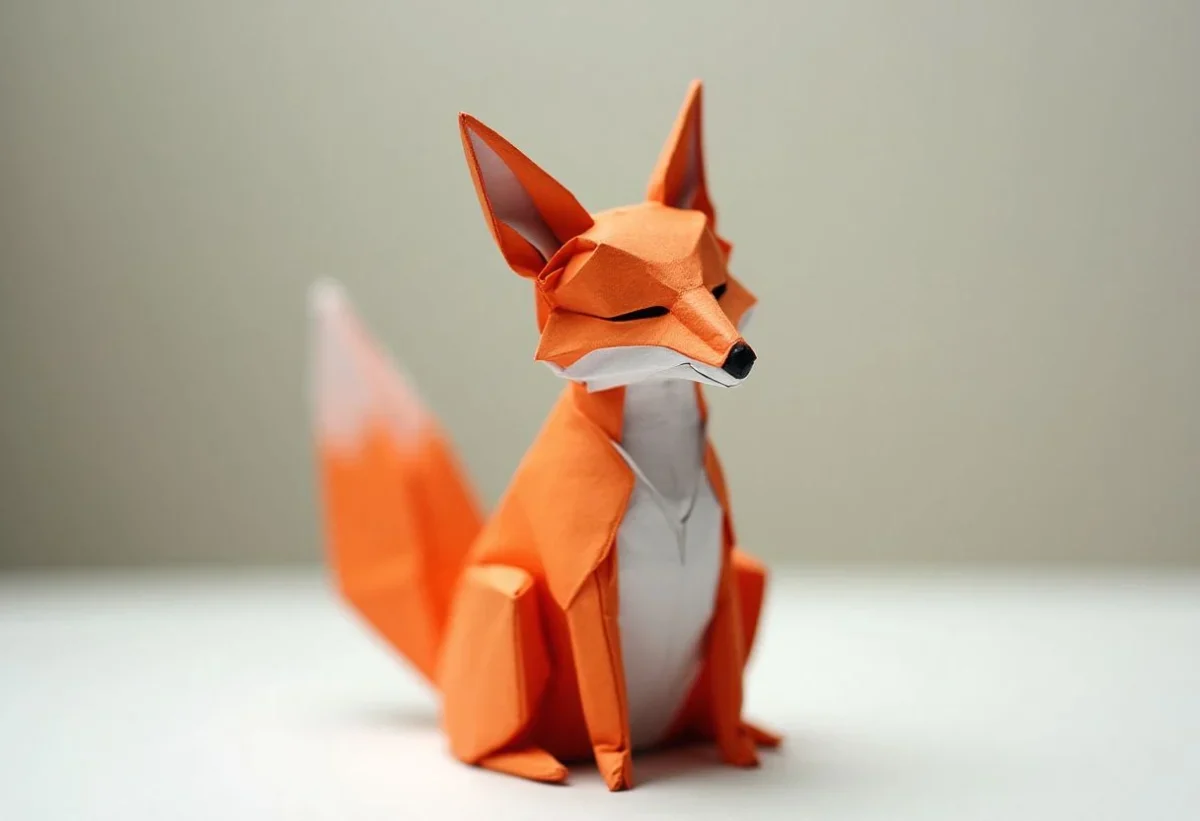
Origami, this ancient Japanese art that transforms a simple sheet of paper into a complex work of art, has today taken on a new dimension with the emergence of 3D origami. Among the most fascinating creations, 3D origami animals captivate with their realism and elegance. This process requires not only creativity but also undeniable mathematical precision.
The origins and evolution of 3D origami
The roots of origami date back several centuries, but 3D origami as we know it today is an exciting evolution of this traditional art. This type of origami introduces additional complexity by allowing the creation of three-dimensional structures, thus offering a new way to explore form and space.
- Japanese origins: although origami is of Japanese origin, its three-dimensional version has gained worldwide popularity, allowing this tradition to transcend cultural boundaries.
- Technical evolution: 3D origami requires a deep understanding of mathematics and geometry, making this art not only creative but also intellectually stimulating.
- Global influence: the evolution of 3D origami has been influenced by various cultures, each bringing its own techniques and styles to the mix, thus enriching this art with new perspectives.
The art of folding animals: decoding the techniques
Creating a 3D origami animal is a true artistic challenge. Artists use various techniques to bring detailed and expressive creatures to life while maintaining the minimalist essence of traditional origami.
- The modular technique: this method relies on assembling several separately folded paper pieces. Each module is an integral part of the whole, giving the sculpture its final shape.
- Wet-folding: a process that involves moistening the paper to make it more pliable, allowing for more natural curves and shapes in animal creations.
- Mathematical folds: the use of advanced mathematical concepts is often essential for designing complex three-dimensional shapes with precision.
Essential materials and tools
The choice of materials and tools is crucial for successfully creating 3D origami. Each element plays a determining role in the quality and durability of the final work.
- Paper: selecting the right paper is essential. Paper that is too thick can be difficult to handle, while paper that is too thin may tear easily. Papers specifically designed for 3D origami are often the best choice.
- Folding tools: while traditional origami requires only a pair of hands, 3D origami can benefit from the use of tools such as bone folders to refine corners or tweezers to manipulate small pieces.
The emotional and artistic impact of 3D origami animals
3D origami animals are not just artistic representations; they are also a powerful means of emotional expression. Each fold, each curve, tells a story and evokes various emotions.
Artists manage to breathe life into their creations. A simple paper tiger may seem ready to pounce, a bird ready to take flight. These works are not only admired for their beauty but also for their ability to capture the very essence of animal life. Through these sculptures, creators explore not only physical form but also the soul of the animal, transcended by the delicacy of paper.
What sets 3D origami apart is its ability to transform a simple sheet into a complex and multidimensional work of art. 3D origami animals are a testament to the artist’s mastery and the expressive power of this ancient art.