
A grammatical class refers to the category to which a word belongs, regardless of the sentence in which it appears. Nouns, verbs, adjectives, determiners, and adverbs are grammatical classes. Distinguishing these categories helps to understand how agreement works in the noun group, subject-verb agreement, and, more broadly, the construction of a sentence in French.
Variable words and invariable words: the first classification to master
Before precisely naming each grammatical class, the most useful reflex is to determine whether a word can change form. A variable word changes according to gender, number, person, or tense: nouns, determiners, adjectives, pronouns, and verbs fall into this category.
An invariable word always retains the same form. Adverbs, prepositions, conjunctions, and interjections do not take plural markers or conjugation endings. Knowing how to make this first classification helps avoid frequent agreement errors, such as treating an adverb as if it were an adjective.
This binary classification forms the basis of any grammar exercise on the nature of words. Working from corrected PDF exercises on grammatical classes helps automate this sorting reflex, because the PDF format allows for reviewing corrections at one’s own pace, without an interactive interface that imposes a tempo.

Grammatical classes of the noun group: noun, determiner, adjective
The noun group is the most productive training ground for identifying grammatical classes. Three categories systematically intersect here.
The noun and the determiner
The noun designates a reality (person, object, concept). It is almost always preceded by a determiner, which specifies its gender and number. In “les évaluations nationales,” “les” is a determiner (definite article) and “évaluations” is a common noun.
The French programs for cycle 3 (BO n°16 of April 17, 2025) associate the identification of the noun and the determiner with the skill of agreement in the noun group. Spotting the determiner means identifying the provider of information about gender and number.
The qualifying adjective
The adjective adds a characteristic to the noun. It agrees in gender and number with it. The frequent difficulty lies with adjectives that are distant from the noun they qualify, or with color adjectives that follow specific agreement rules.
A typical exercise asks to classify each bold word in a sentence. When the word “orange” appears in “la couleur orange” (invariable adjective) and then in “l’orange est juteuse” (noun), the same word changes class depending on its function in the sentence. This type of trap regularly appears in grammar assessments.
Verb and pronoun: the classes that structure the sentence
The verb expresses an action or a state and is conjugated according to person, number, tense, and mood. It is the core of the sentence. Identifying the conjugated verb then allows one to find the subject (who performs the action) and the complements (COD, COI).
The pronoun replaces a noun or a noun group already mentioned. “Il,” “leur,” “celui-ci” are pronouns. The most common confusion concerns words that can be a determiner or a pronoun depending on the context. “Le” in “le chat” is a determiner; “le” in “je le vois” is a personal pronoun.
The CM2 benchmarks published by éduscol in 2026 evaluate this skill using a format of reasoned choice among four options. The student must identify the grammatical nature of an underlined word by selecting the correct answer, which engages active reasoning rather than rote definition recitation.
Adverb, preposition, conjunction: the invariable classes in exercises
Invariable words pose a different problem: since they never change form, one cannot rely on an ending to identify them. It is necessary to understand their role in the sentence.
- The adverb modifies the meaning of a verb, an adjective, or another adverb. “Constamment,” “très,” “demain” are adverbs. A simple test: the adverb can often be removed without making the sentence incorrect.
- The preposition introduces a complement and creates a dependency link between two elements. “Dans,” “pour,” “depuis,” “pendant” are prepositions. They cannot be removed without breaking the construction.
- The conjunction connects two words, two groups, or two clauses. “Et,” “mais,” “car” (coordinating conjunctions) and “lorsque,” “que,” “parce que” (subordinating conjunctions) belong to this class.
In the PDF exercises, sentences intentionally mix several invariable words to force the distinction of these three categories. For example, in “il neige constamment depuis trois jours, mais on annonce une amélioration pour demain,” four invariable classes coexist.
Method to progress with corrected PDF sheets
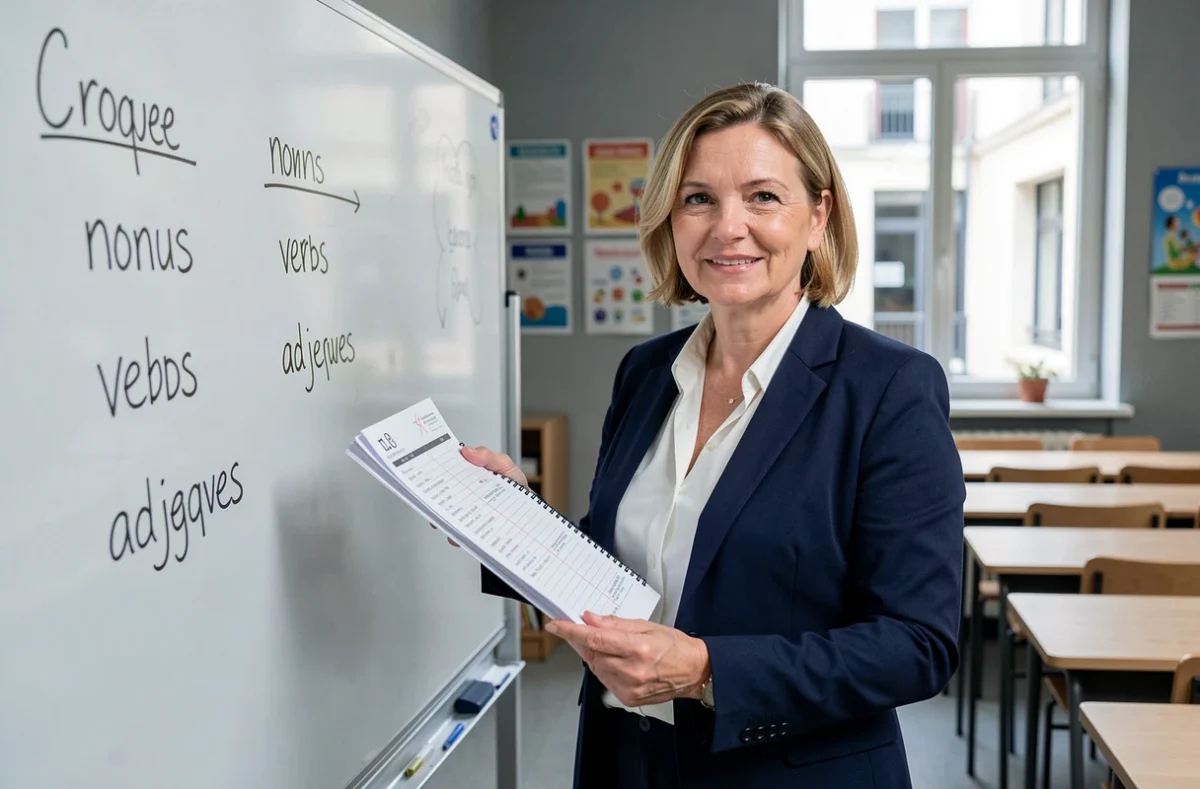
The corrected PDF format presents a specific pedagogical advantage: it separates the reflection time from the correction time. On an interactive screen, the answer often appears too quickly, before the reasoning is complete.
An effective progression follows a precise order:
- Start with the variable/invariable sorting on isolated words to anchor the basic reflex.
- Move on to identifying classes in short sentences, where only one word is targeted at a time.
- Finish with long sentences containing traps (same word, two possible classes depending on the context).
- Review the corrections by noting each recurring error to target future revisions.
The tool positioning library of éduscol offers a specific module titled “Grammar: grammatical classes,” designed to identify concepts not mastered and adapt the subsequent work. This diagnostic logic goes beyond simple accumulation of sheets: it directs towards exercises that are truly useful for each profile.
Identifying grammatical classes remains a transversal skill in French. It conditions grammatical spelling, text comprehension, and writing. Regular practice on corrected sheets, even with just a few sentences a day, is enough to stabilize knowledge that will be useful from CM2 to the diploma.