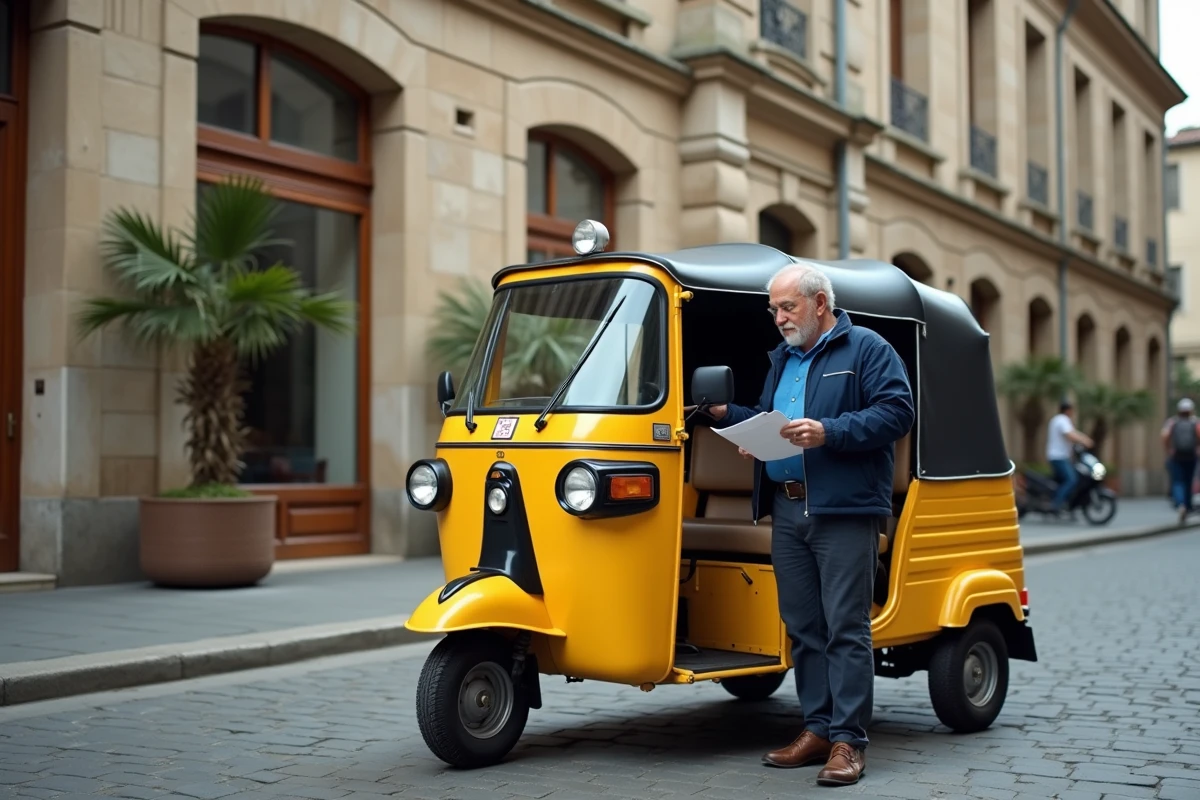
The tuk tuk is increasingly attracting entrepreneurs and individuals in France, whether for tourist transport in city centers or as an original advertising vehicle. Before signing an order form, the question of price quickly collides with that of homologation, a technical prerequisite that conditions everything else. How much does a tuk tuk ready to roll on French territory actually cost, and what steps separate the purchase from putting it into circulation?
Categories L2e and L5e: the regulatory framework that determines the price
A tuk tuk intended to circulate in France must meet European approval (CE homologation) or national approval on a case-by-case basis (RTI). The vehicle’s category depends on its number of wheels, its engine type, and its weight. Three-wheeled models generally fall under categories L2e (limited engine capacity, speed capped) or L5e (motorized tricycle without speed limitation). This distinction radically changes the final bill.
A vehicle classified as L2e can be driven with an AM or B license, which broadens the customer base. In contrast, more powerful L5e models require at least a B license. The transition from one category to another also alters the cost of car insurance and the constraints of technical inspections.
The possibility of buying a homologated tuk tuk in France directly from an authorized importer simplifies the process: the vehicle arrives with its certificate of conformity, ready for registration at the prefecture. Importing a tuk tuk from Asia or India oneself requires financing the individual homologation, a lengthy and costly process that can represent several thousand euros in additional costs.
New or used tuk tuk: comparative cost table in France
Prices vary according to the engine type (diesel, gasoline, electric), the brand, and the condition of the vehicle. The table below summarizes the price ranges observed in the French market for homologated models.
| Type | Engine Type | Price Range | Note |
|---|---|---|---|
| New – entry-level | Gasoline / diesel | Several thousand euros | Piaggio Ape models or equivalent imported Asian models with homologation |
| New – mid / high-end | Electric | Significantly higher than a thermal model | Lithium batteries, variable autonomy, possible eligibility for local subsidies |
| Used | Gasoline / diesel | Lower than a new equivalent model | Check the condition of the registration certificate and the validity of the homologation |
| Used – imported non-homologated vehicle | Variable | Low purchase price, but RTI cost to add | The RTI can double the initial budget |
The Piaggio Ape remains the most common reference in the French market, thanks to its native European homologation and an accessible spare parts network. Asian brands (Bajaj, TVS) offer lower purchase prices, but the additional cost of homologation and the availability of parts in France often balance the scales.
Electric tuk tuk: a cost to put into perspective
Electric models have a higher list price than thermal versions. The gap narrows in use due to lower energy costs and the absence of traditional engine maintenance (oil changes, filters). Some low-emission zones (ZFE) in cities now impose restrictions on diesel vehicles, making the electric choice strategic for tourist transport activities in city centers.
Registration procedures for a homologated tuk tuk in France
Once the homologated vehicle is acquired, the registration follows a precise administrative path. Here are the steps to follow:
- Obtain the European Certificate of Conformity (COC) from the manufacturer or authorized importer, a document that certifies that the vehicle meets current technical standards.
- Compile the ANTS (National Agency for Secure Documents) file with the COC, proof of residence, an identity document, and the Cerfa form for the registration request.
- Pay the regional tax and the processing fee, the amount of which varies by region and the vehicle’s fiscal power.
- Take out car insurance suitable for the vehicle’s L category before putting it into circulation.
Without a valid certificate of conformity, no registration certificate will be issued. This is the most common bottleneck for buyers importing a tuk tuk directly from a non-European Union country.
Individual approval: the case of non-homologated vehicles
For a tuk tuk purchased abroad without CE homologation, the DREAL (Regional Directorate for the Environment, Planning, and Housing) organizes the individual approval. The vehicle is physically inspected: compliance of braking systems, lighting, pollutant emissions, chassis structure. This RTI procedure can take several months and sometimes requires costly technical modifications to bring the vehicle up to French standards.

Choosing between professional and personal use: technical criteria
The choice of a tuk tuk is not solely based on the purchase price. The intended use significantly alters the selection criteria.
For professional use (passenger transport, guided city tours, advertising vehicle), the robustness of the chassis and loading capacity matter more than top speed. Urban areas limit speed, and trips are short. A reliable engine and easy access to spare parts take precedence over power.
For personal use, parking and space considerations guide the choice. A three-wheeled tuk tuk parks more easily than a conventional car, which is a concrete advantage in dense cities. However, driving comfort over long distances remains limited compared to a conventional automobile.
- Professional use in the city: prefer a homologated electric model, compatible with ZFE, with comfortable passenger space.
- Advertising or event use: customization of the bodywork (wrapping, interior layout) adds a budget item to anticipate.
- Daily personal use: check the availability of a service and parts network in your area before purchasing.
The tuk tuk market in France remains a niche segment. Delivery times for a new homologated model can reach several weeks, and the used market remains tight. Comparing offers from several authorized importers before committing helps avoid additional costs related to incomplete homologation or non-existent after-sales service in the territory.